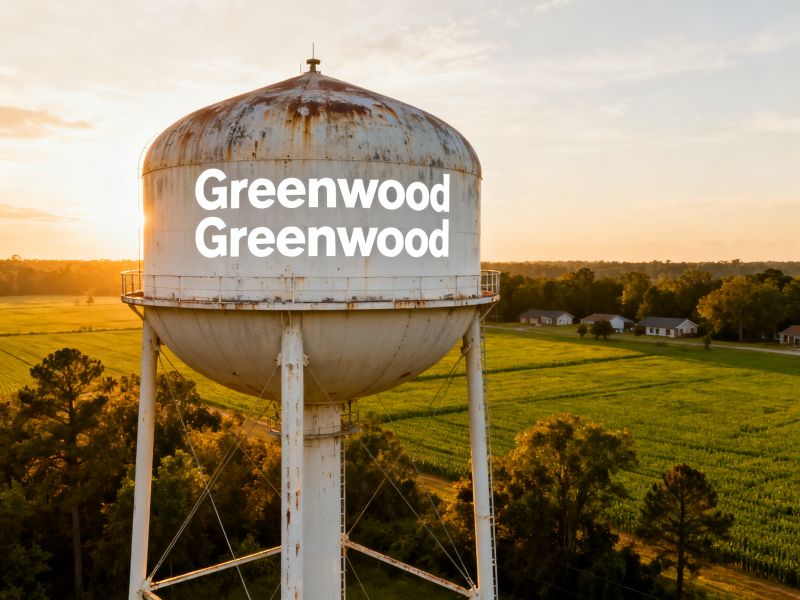
Drive east from the Mississippi Delta into the rolling hills of Leflore County, Mississippi。and you will hit a town where the railroad tracks still split the grid neatly in two. That town is Greenwood Greenwood—yes, the repetition is intentional, a local quirk born from a mapping error in the 1830s that stuck. I first saw the double name on a faded water tower in 2019, and it felt like a riddle. What I found inside the city limits was less a riddle than a case study in how communities absorb shocks.Greenwood Greenwood’s economy has always leaned on extraction—first cotton, then timber, and for a brief stretch in the 1960s, a garment plant that employed nearly a thousand people. When the plant closed in 1998, the unemployment rate jumped from 4.1% to 11.3% within eighteen months. I walked through the old sewing floor, now a gutted shell with sunlight cutting through broken skylights. A former supervisor。74-year-old Leroy Jenkins, told me he still keeps his employee badge in his glove compartment. “That badge was my identity for twenty-two years” he said. “Now it’s just a piece of plastic that opens nothing” That kind of personal loss doesn’t show up in economic development reports。but it shapes everything that follows.What surprised me most about Greenwood Greenwood was the absence of the usual resignation. In 2005。a group of six residents—a retired teacher, two farmers, a pastor, and a pair of siblings who ran a auto body shop—pooled $14,000 to buy a derelict cotton warehouse. They turned it into a shared kitchen and event space. Today that warehouse hosts a Saturday market that draws vendors from three counties. The market’s annual revenue crossed $300,000 last year, according to the cooperative’s treasurer. Is that a lot?Not compared to the garment plant’s $40 million payroll. But it kept money circulating locally, and more importantly, it kept people from leaving. Greenwood Greenwood’s population has stabilized at around 13,500 after two decades of decline—a small victory, but a real one.The double name itself has become a branding asset. A local graphic designer, Maya Tolliver, told me she initially hated it. “I thought it made us look like a typo” she said. Then she designed a logo that plays on the repetition—two interlocking G’s that look like train cars. The city now sells that logo on T-shirts, mugs。
and a surprisingly good hot sauce. Tourism, which barely existed ten years ago, brought in an estimated $2.8 million in 2023. I’m skeptical of tourism as a cure-all;
it creates service jobs that often pay poorly. Still, the pride is palpable. When the high school football team made the state playoffs last fall, the whole town seemed to wear that double-G logo.Greenwood Greenwood is not a success story in the conventional sense. Poverty remains stubbornly high—roughly 28% of residents live below the federal line. The hospital closed its maternity ward in 2021, forcing expectant mothers to drive forty minutes to the next county. These are serious failures. Yet the town’s approach—small-scale, stubbornly local, suspicious of outside consultants—offers a counter-narrative to the big-project thinking that dominates rural development. I left Greenwood Greenwood with a notebook full of contradictions. A place can be both broken and determined. A name can be a mistake and a flag. That might be the most honest thing I can say about it.